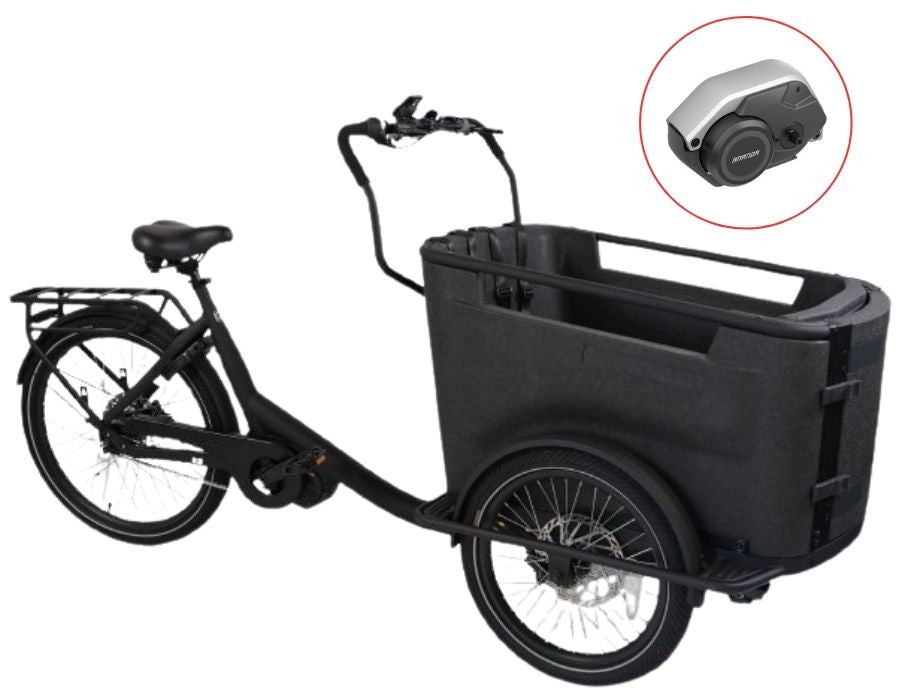
urban lastenfahrrad Van Rixtel Urban Plus Nexus 5 – Elektrisches Lastenrad – Lastenfahrrad-Profi
SKU: 31625115321
urban lastenfahrrad

urban lastenfahrrad Van Rixtel Urban Plus Nexus 5 – Elektrisches Lastenrad – Lastenfahrrad-Profi

Sale price$19.29 Regular price$21.43
Save 10%

Pay in installments of $5.36 with ShopPay, AfterPay and Klarna

Shipping Estimate
USA
  • USA
  • CAN

Ships within 48 hours · Estimated delivery Jul 3 - Jul 8

Promo Codes Available:

For Your Every Summer RSVP, with Code: SUMMER15

Description

urban lastenfahrrad Van Rixtel Urban Plus Nexus 5 – Elektrisches Lastenrad – Lastenfahrrad-ProfiVan Rixtel Urban Cargo: Stilvoll, praktisch und langlebig Das Van Rixtel Urban Cargo Lastenrad vereint Stil und Funktionalitt in einem Premium Design. Dieses Modell besticht durch seine robuste und elegante Formgebung sowie eine grozgige EPP Transportbox, die sich ideal fr den Transport von Kindern, Haustieren oder Alltagsgegenstnden eignet. Die Box ist so konstruiert, dass sie wetterbestndig ist und selbst Regen, Wind und Sonne problemlos standhlt fr

Van Rixtel Urban Cargo: Stilvoll, praktisch und langlebig

Das Van Rixtel Urban Cargo Lastenrad vereint Stil und Funktionalität in einem Premium-Design. Dieses Modell besticht durch seine robuste und elegante Formgebung sowie eine großzügige EPP-Transportbox, die sich ideal für den Transport von Kindern, Haustieren oder Alltagsgegenständen eignet. Die Box ist so konstruiert, dass sie wetterbeständig ist und selbst Regen, Wind und Sonne problemlos standhält – für eine lange Lebensdauer ohne Qualitätseinbußen.

Dank des leistungsstarken Mittelmotors und der hochwertigen Shimano-Schaltung bewegt sich das Lastenrad mühelos und geschmeidig durch die Stadt – selbst bei voller Beladung. Die perfekte Wahl für Familien und urbane Abenteurer, die eine zuverlässige und stilvolle Transportlösung suchen.

Highlights des Van Rixtel Urban Cargo

+ Kraftvoller Ananda M100-Mittelmotor mit 120 Nm Drehmoment

+ Robuste, wetterbeständige EPP-Box für vielseitige Nutzung

+ Samox hydraulische Scheibenbremsen

+ Shimano Nexus Schaltung

+ Hohe Zuladung für unterschiedlichste Transportbedürfnisse

Wetterbeständige EPP-Box für vielseitigen Einsatz

Die geräumige EPP-Transportbox des Van Rixtel Urban Cargo ist auf Langlebigkeit und Widerstandsfähigkeit ausgelegt. EPP (Expanded Polypropylene) ist bekannt für seine Festigkeit und stoßdämpfenden Eigenschaften. Die Box schützt Ihre Ladung zuverlässig – unabhängig vom Wetter – und bietet ausreichend Platz für Kinder, Haustiere, Einkäufe oder Sportausrüstung.

Ob auf dem Weg zur Schule, in den Park oder einfach durch die Stadt: Die EPP-Box sorgt dafür, dass alles sicher und trocken ankommt. Zudem verleiht die hochwertige Verarbeitung dem Lastenrad ein modernes Design, das perfekt zum urbanen Lebensstil passt.

Leistungsstarker Ananda M100-Mittelmotor mit 120 Nm Drehmoment

Das Van Rixtel Urban Cargo ist mit dem kraftvollen Ananda M100-Mittelmotor ausgestattet, der beeindruckende 120 Nm Drehmoment liefert. Diese Motorbauweise ist bekannt für ihre dynamische, natürliche Fahrunterstützung und sorgt dank der zentralen Platzierung für optimale Gewichtsverteilung. Das Ergebnis: hervorragende Stabilität und Wendigkeit – ob in engen Straßen, beim Bergauffahren oder bei voller Beladung.

Das hohe Drehmoment erleichtert das Anfahren aus dem Stand, selbst bei schweren Lasten. Damit ist dieses Lastenrad die ideale Lösung für urbane Abenteuer und Familienausflüge.

Kraftsensor
Der Ananda M100 ist mit einem Kraftsensor ausgestattet, der die Motorleistung präzise an die Pedalkraft anpasst. So wird nur dann zusätzliche Unterstützung gegeben, wenn Sie sie wirklich benötigen – was die Energieeffizienz deutlich erhöht. Diese Technik macht den Motor sparsamer als einen Vorderradmotor und sorgt für ein sehr natürliches Fahrgefühl.

Technische Daten

Spezifikationen

Marke Van Rixtel
Modell Urban Plus Nexus
Rahmenmaterial Aluminium
Material der Box EPP (Expandiertes Polypropylen)
Rahmengröße Für alle passend
Radgröße Vorne: 20 Zoll, Hinten: 26 Zoll
Gewicht ohne Akku ca. 65 kg

Elektrische Daten

Akkuleistung 450 Wh / 540 Wh
Akkutyp Lithium-Ionen
Reichweite bis zu 50–80 km
Motor Ananda M100 Mittelmotor (120 Nm)
Display LCD-Farbdisplay
Unterstützungsstufen 5 (einstellbar)
Sensor Kraftsensor
Maximale Geschwindigkeit 25 km/h (gesetzlich zulässig)

Allgemein

Abmessungen 220 x 89 cm (LxB)
Innenmaß Box (oberer Rand) 80 x 59 cm
Innenmaß Box (Sitzhöhe) 76 x 56 cm
Innenmaß Box (Boden) 75 x 54 cm
Lenkung Leichtes, stabiles Lenken durch smarte Konstruktion
Schaltung 5-Gang Shimano Nexus
Felgen Speichenfelgen
Maximale Belastung Fahrer: 100 kg, Box: 60 kg, Gepäckträger: 25 kg

Sicherheit

Bremse vorne Hydraulische Scheibenbremsen
Bremse hinten Hydraulische Scheibenbremsen
Beleuchtung vorne LED-Beleuchtung (automatisch, Akku-betrieben)
Beleuchtung hinten LED-Beleuchtung (automatisch, Akku-betrieben)
Reflektionsstreifen auf Reifen Ja
Anti-Rutsch-Pedale Ja
Akkuschloss Ja
Shipping Notes
  • Free Standard Shipping on $100+ Orders to the USA.
  • Except Preorder products are shipped in 48 hours.
  • Delivery to the USA:
  1. Standard Shipping : 3-10 business days
  • If time is of the essence, please consider selecting expedited delivery for faster service.
Exchange/Return Notes
  • We offer a 30-day return/exchange service after receiving.
  • Final sale items are not eligible for returns or exchanges.
  • To process your return/exchange, please contact us at [email protected]
  • Please click here for more details>>> Return & Exchange Policy
SKU: 31625115321

Discover Niche Categories That Outsell urban lastenfahrrad

Top-Converting Item to Boost Your Average Order

4.9 ★★★★★
Based on 672 reviews
Sort
Highest Rating
Newest First
Oldest First
Product Reviews
J
Verified Purchase
Joseph Somma
Charlottesville, US
★★★★★ 5
Thorough history
Format: Hardcover
Levy provides a masterful history of American capitalism. His work is detailed and brilliantly written. You should buy this book for its last section: the age of chaos. Here Levy details the US economy since Reagan and identifies critical trends and questions we all need to address. This is not a book for a casual reader, each chapter is hard work. However, the rewards more than outweigh the effort.
WAS THIS REVIEW HELPFUL?YesReportShare
Reviewed in the United States on December 19, 2021
J
Verified Purchase
Joseph
Port Orchard, US
★★★★★ 5
An interesting look at capitalism in the US
Format: Hardcover
Seller: Product arrived on time in good condition. No issues with the seller at all! Book: This is a pretty dense history of the US through the lense of capitalism. There are quite a few editing errors (typos, incorrect quotation formatting, etc) that are speed bumps to the flow of this book but don’t ruin the reading experience. There are also a few moments where a subjective claim is made using a historical event as a backdrop, but the claim isn’t elaborated on as well as it could be. I chalk this up to the focus of the book being on history and not economics, but I do think if a claim is made it would be interesting to have more data as to why the claim was made.
WAS THIS REVIEW HELPFUL?YesReportShare
Reviewed in the United States on December 5, 2023
G
Verified Purchase
Gary Moreau, Author
Fort Morgan, US
★★★★★ 4
Marx had the proletariat, Mao had the farmers, America has the owners of financial capital
Format: Kindle
What makes Jonathan Levy’s book so informative is that it is truly a parallel history of its politics and its economics. And only by viewing these two intertwined paths side by side can you truly understand the myth of the American free market. America’s politics and its economics have never, since the country’s founding, been separated. The state has been an integral part of everything economic to an extent that would make the most rabid socialist gasp in horror. The only difference is that while the Marxist state stood side by side with the proletariat, and Mao built the number two economy in the world on the support of farmers, America built its economic marvel on the backs of, and for the benefit of, the owners of financial capital. That’s not all bad, mind you. It takes workers, farmers, and the owners of capital to build a modern economy. The tension comes when there is a lack of balance between the importance the state attaches to each. And there can be little surprise that America’s politicians have put the owners of financial capital at the top of their list of priorities. Politicians, after all, can do nothing without power, and power comes via the electoral process, a process that is today fueled by obscene amounts of money. And who has all that money? The American economic narrative is a misleading tale of meritocracy and free markets. The Horatio Alger-based myth is that you are only limited by your skills and your ambition. And like most enduring myths there is a thread of truth to it. Many successful people truly deserve what they have achieved. But does anyone really possess $150 billion of personal merit? Can we statistically accept that the wealthiest nation in the world is also one of the most financially unequal without seeing a pattern of bias? Perhaps the most selectively quoted book in history is Adam Smith’s “Wealth of Nations”, published, strangely enough, in 1776. Often credited with being the father of capitalism, Smith argued that markets free of excessive regulation would be more efficient than markets that were overly regulated, although Smith “made no categorical separation between the political and the economic, or state and market.” Smith did, however, warn against the socially destructive power of monopolies, which unregulated markets will not protect against, and he correctly predicted that the excessive division of labor would lead to a degree of labor and wealth inequity that would destroy society. At the time when US Steel, General Electric, and General Motors, among many others, were the power behind America’s global economic hegemony, most Americans earned a living through wages. And those wages were made possible by long term fixed investments that created jobs. They were generally big bets that took a long time to earn a return but that aligned with the jobs-first priorities of most companies. (Employees first, communities second, shareholders a distant third.) And while not every employee enjoyed the same salary, the differences between the top earners and the average earners was a fraction of what it is today. That era, of course, is long over. The current economy is geared toward the creation of wealth through the short-term investment in assets that will appreciate rapidly and are highly liquid. At the moment that is the stock market and synthetic financial tools pedaled by hedge funds, banks, and the like. The problem is that the wage market encompassed much of America. The asset appreciation market encompasses only a tiny sliver of the richest among us. There is spillover, of course. The lawyers, analysts, consultants, bankers, and sales people who serve the asset appreciation market are doing quite well. But the man or woman who has less education and who might have made a decent living in a steel mill or car assembly plant, has lost out. And despite what the politicians will tell you, the gap is getting wider. (I spent a career in corporate industry, have a college degree in economics, have been a CEO, and have served on four public company boards. I know enough to know that Levy knows what he’s talking about.) The second important point to come out of all this is that economics is not really a “science” as most people think of that term. There is a shared jargon and there are commonly accepted principles. The very idea that there is an economy that is distinct from all other aspects of human existence, including the state, however, is a relatively recent concept. The weakness of the distinction, in fact, is clearly demonstrated by the remarkable reality of just how diverse the history of the American economy is. The sun doesn’t always rise in the east in the world of economics. In each of the economic eras Levy describes it is stunning how few people actually formulated the thinking that defined them. I will join some of the other reviewers in suggesting that the author could have spent more time explaining some of the jargon inevitably found in a treatise on economics. The layman obviously wasn’t his target audience but the book, I believe, could have read more smoothly and been much, much shorter. (The editor and publisher have to take some of the blame for this.) Even if you have to slog your way through the more tedious sections on global capital flows and such, however, you’ll get something from the book even if you’ve never set foot in an economics classroom. If you get no more than the fact that the free market is a myth and that most long term capital that actually creates jobs and income for the average American is actually provided by you, the taxpayer, not the Wall Street capitalist, you will better understand why there is so much division in our country right now. We don’t have a democratic economy. The young wonders of Silicon Valley would have nothing if it wasn’t for your tax dollars and your pension plan, if you’re still lucky enough to have one. We can do better. We have to. The economic inequity we have now is simply not sustainable.
WAS THIS REVIEW HELPFUL?YesReportShare
Reviewed in the United States on August 19, 2022
J
Verified Purchase
Jose Calderon
Omaha, US
★★★★★ 5
Good value for the money.
Format: Hardcover
Book in excellent condition, delivered promptly.
WAS THIS REVIEW HELPFUL?YesReportShare
Reviewed in the United States on May 20, 2025
J
Verified Purchase
Jared Dean
Massapequa, US
★★★★★ 5
Great read.
Format: Paperback
Gives a great perspective of how technology has developed and shaped the economy.
WAS THIS REVIEW HELPFUL?YesReportShare
Reviewed in the United States on January 21, 2024

recommand products